
Business Reporter
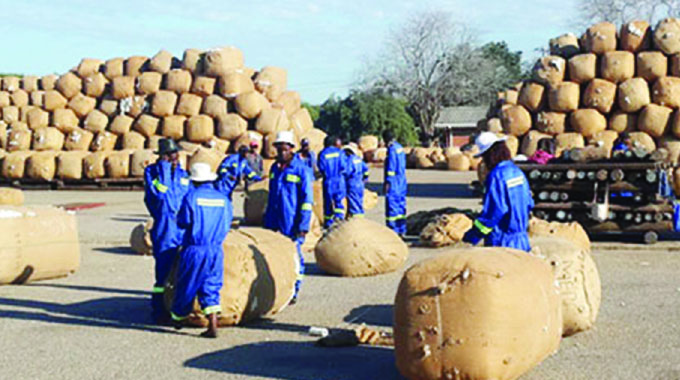
ZIMBABWE’S largest cotton financier, Cottco has paid about US$14,6 million for just over 65 000 tonnes delivered by the farmers this year, the company said in a recent update.
The US$14,6 million represents 66 percent of the money paid for deliveries, leaving outstanding payments of US$7,6 million, Cottco, which administers the Government’s Free Cotton Inputs Scheme supporting over 300 000 households, said.
The cotton growers are paid 85 percent in foreign currency and the remainder in Zimbabwe dollars at the prevailing official exchange rate. The lowest grade will fetch US40c per kilogramme and the best quality grade (A) is being sold for US46c per kilogramme.
Cottco was targeting 100 000 tonnes from about 46 000 tonnes last season, but it is highly unlikely that the target would be met as the curtain comes down on the 2023 marketing season.
The raw cotton intake by the private contractors, as of last week, was nearly 21 000, putting the national output at 86 000 tonnes.
The Gokwe business unit had the highest portion of cotton delivered at 23 percent, followed by Sanyati, 17 percent, Chiredzi, 16 percent, Muzarabani, 12 percent Chinhoyi, 10 percent.
Some smaller quantities came from business units in Mutare, Kadoma, Mutoko, and Lupane where Cotton is trying to either resuscitate or scale up cotton production.
Since the launch of the State-assisted scheme, production has been steadily going up with occasional dips in drought years. The scheme has helped in the resuscitation of the cotton industry which is a major source of employment for countryside farmers.
Financially, cotton has been bringing in an average of US$70 million annually, according to official statistics.
However, there are growing calls to invest more in value addition facilities. The current spinning capacity cannot absorb the 30 percent of lint earmarked for the local industry because there is not much room to value addition along the textile value chain.
Over the past 10 or so years, the area under production for cotton has been gradually falling.
The declines in area under production are largely due to high input costs, withdrawal of contractors as well as induced farmer withdrawal due to lower producer prices.
The average productivity for the past decade is at 0,55 tonnes per hectare.
The low productivity has been attributed to droughts, diseases, the effects of climate change, as well a shortage of manpower especially during weeding and picking periods leading to falling productivity as well as the emergency of ratoon crops, according to the Agricultural and Marketing Authority (AMA) country report for 2021/22.
Cotton production is largely practiced by smallholder farmers in Zimbabwe with an average of one hectare for every farmer. Production is mainly done in averagely drier parts of the country with considerably high temperatures and rainfall amounts averaging 500mm per annum.
Major growing areas include Gokwe, Sanyati, Kadoma, Muzarabani, Mt Darwin, Chipinge, Chiredzi and Manicaland.
Meanwhile, Cottco has started deploying inputs to business units ahead of the next cropping season.