
‘The framers of our constitution understood that there may come a day when those in positions of authority would seek to alter constitutional terms of office’
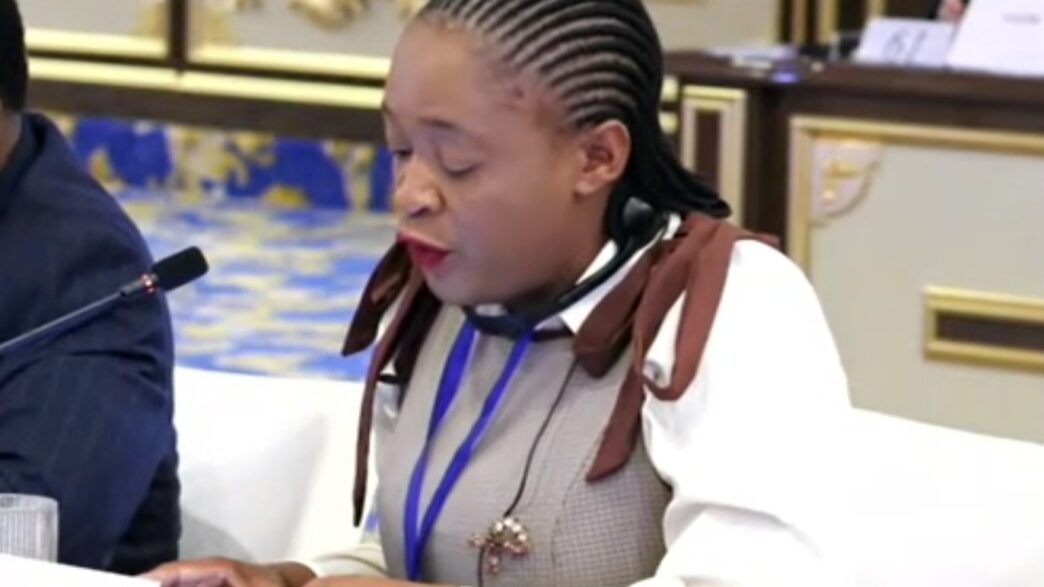 Matabeleland South senator Nonhlanhla Mlotshwa
Only 4 senators voted against the passage of Constitution of Zimbabwe Amendment Bill (No.3), 2026. Among them was Nonhlanhla Mlotshwa, the senator for Matabeleland South. Just before the Senate was divided, Mlotshwa made a stirring contribution, laying out her objections to the Bill’s passage. Here is what she said:
I RISE today to debate the Constitution of Zimbabwe Amendment Bill (No.3), 2026. I do so fully aware that this debate cannot and should not be reduced to a simple question of “yes” or “no.” The Bill is bigger than that. It is bigger than the political parties represented in this House. It is bigger than the government of the day. It is bigger than the opposition. It is bigger than the individuals who occupy public office today.
This Bill will outlive all of us. Long after we have left these chambers and long after today’s political contests have faded into history, the constitutional choices we make today will continue to shape the Republic of Zimbabwe. That is why constitutional amendments demand a higher standard of scrutiny than ordinary legislation. When we debate ordinary Bills, we debate policy. When we debate constitutional amendments, we debate power itself. We debate who exercises power, how power is acquired, how power is restrained and transferred. Most importantly, we debate how power is prevented from becoming greater than the constitution itself.
Parliament’s duty is not to make the work of the executive easier. We are here to hold the executive accountable. We are not an extension of the government but are representatives of the people. The constitution is therefore not a document designed for the convenience of those who govern. It is a document designed to protect those who are governed. That is why constitutional amendments must always be approached with caution, humility and an unwavering commitment to the national interest.
The constitution is sacred because it is the supreme expression of the will of the people of Zimbabwe. It must never become a tool for the convenience of the powerful. It must remain a shield for the ordinary citizen.
One of the most important provisions in our constitution is Section 328. The framers of our constitution understood that there may come a day when those in positions of authority would seek to alter constitutional terms of office.
That is why Section 328(7) was included. It provides that where an amendment extends the length of time that a person may hold office, that extension must not benefit the incumbent office holder. That safeguard was deliberate. It was designed to ensure that constitutional amendments are made for the republic and not for individuals. It was designed to protect constitutionalism itself.
The principle behind that section is simple. No person should participate in altering constitutional rules and then become the immediate beneficiary of those alterations.
The constitution anticipated the temptation of power. It therefore created guardrails against that temptation. As legislators, we should be strengthening those guardrails, not weakening them. This is because once constitutional safeguards become negotiable, constitutional democracy itself becomes negotiable. The question before us is therefore not who occupies office today. The question is what precedent we establish for tomorrow. Every constitutional amendment creates a precedent. Future governments will point to today’s decisions when justifying future constitutional changes. That is why we must think beyond the present political moment. This Bill will outlive all of us.
The constitutional choices we make today will govern people who have not yet voted, who have not yet been born and who will one day inherit the republic we leave behind. Supporters of aspects of this Bill have argued that reducing election cycles, reducing electoral contestation and extending terms will reduce public expenditure, reduce political toxicity and create sufficient time for government programmes and development projects to be completed. Those are serious arguments.
Every Zimbabwean desires peace, stability and development. If those are the reasons being advanced for altering constitutional arrangements, then parliament has a duty to ask an equally serious question: Where are the savings going to? If elections are expensive and constitutional changes are being justified partly based on reducing those costs, then this House must be told exactly how much money will be saved. We must know how those figures were calculated, how much will be saved over the proposed period, which ministries will benefit, which projects will receive those resources and how parliament will monitor the utilisation of those funds. The people of Zimbabwe have a right to know.
The people do not experience constitutional amendments in theory. They experience government through roads, clinics, schools, water systems and completed infrastructure projects. That is where constitutional promises must ultimately be measured. As we stand here today, many communities continue to face serious infrastructure challenges. In Matabeleland South, roads remain unfinished. Citizens continue to travel on roads that should have been completed years ago. Even some of the Independence Day projects that were announced with great national excitement remain incomplete.
The roads associated with those projects have not all been completed and the people continue to wait.
These roads are not statistics to some of us. They are the roads our people use everyday. Those are the roads pregnant mothers travel on to reach clinics. Those are the roads farmers use to take their produce to the market. Those are the roads schoolchildren use to reach education. That is why development cannot remain a slogan. Therefore, if the government argues that constitutional changes will save money and create the conditions necessary for development, parliament must insist that those savings be directed towards unfinished development projects.
The people cannot drive on constitutional amendments and cannot transport their livestock and produce on constitutional amendments. They require roads, infrastructure and completed projects. Most importantly, they require evidence that constitutional changes are improving their lives. If election savings form part of the justification for this Bill, then parliament should receive annual reports detailing the exact amount saved, where the resources were allocated, which projects benefited and what measurable outcomes were achieved. That is not opposition politics but accountability. That is parliamentary oversight.
If not, we risk amending the supreme law of the republic based upon promises of savings that are never measured, reported and never felt by the people we represent.
One of the greatest weaknesses in our political system is the winner-takes-all nature of our elections. Every election becomes a battle for total control. Every election produces winners who take everything and losers who are excluded from meaningful participation. The result is political polarisation and division. The result is a political culture where compromise becomes impossible.
I therefore submit that Zimbabwe should seriously consider moving towards a full proportional representation electoral system. A proportional representation system ensures that every vote counts. It allows broader representation, accommodates diverse political opinions, reduces the politics of exclusion and lowers the stakes of elections because political participation is no longer an all-or-nothing exercise. If we are serious about reducing political toxicity, then electoral reform deserves greater attention than constitutional alterations relating to terms of office.
The answer to political tension is not concentration of power. The answer is broader participation in power. A full proportional representation system would ensure that parliament reflects the diversity of views that exist within our nation. No citizen should feel that their vote has been wasted. No region should feel permanently excluded. No political opinion should be rendered irrelevant simply because it did not win a particular constituency. That is how mature democracies build consensus. That is how nations strengthen legitimacy.
Still debating the issue of representation, I believe that this House must also reflect on the issue of the 10 senators with voting powers appointed by the president. If appointments are to form part of our constitutional architecture, then those appointments should strengthen democratic representation rather than distort it.
The spirit of proportional representation is that the composition of parliament should, as far as possible, reflect the will expressed by voters. The results of the 2023 elections produced a Senate in which the ruling party secured 33 seats while the opposition secured 27 seats. Those numbers tell an important story. They demonstrate that millions of Zimbabweans voted for parties represented on both sides of this House.
The electorate did not create a Senate that belongs to one political party alone. The electorate created a Senate that reflects political diversity. Therefore, if appointed senators are to remain, consideration should be given to ensuring that such appointments broadly reflect the political balance expressed by voters. In my respectful view, appointments should not overwhelmingly benefit one political side while excluding another.
If the electoral outcome represented both government and opposition, then any system of appointments should respect that reality. Doing so would strengthen confidence in parliament, strengthen inclusivity and strengthen national cohesion. Most importantly, it would reinforce the principle that every voter matters.
If this Bill seeks to reduce political tensions and strengthen national unity, then representation must also be seen to be fair. Democracy is strongest when institutions belong to everyone. It is weakest when institutions are perceived to belong to one side. I, therefore, submit that consideration be given to allocating appointed Senate positions in a manner that broadly reflects the political balance expressed by the electorate in the 2023 election.
I also want to speak of independent institutions that must remain independent. No democracy survives because leaders are good. It survives because institutions are strong. Strong institutions protect citizens from abuse of power, governments from accusations of abuse and they also create legitimacy.
I, therefore, approach with caution any proposal that may weaken the independence of constitutional bodies. Electoral institutions must enjoy public confidence; the delimitation process must enjoy public confidence and voter registration systems must enjoy public confidence. The moment citizens begin to doubt the independence of institutions, democracy suffers. Zimbabwe should be strengthening independent institutions and not weakening them. We should be increasing transparency and not reducing it. We should be building trust and not creating suspicion.
One of the issues that has generated considerable debate in this Bill is the proposal relating to voter registration and the role of the Registrar General. I fully appreciate the argument advanced by those who believe that the Registrar General possesses administrative infrastructure throughout the country and may therefore be capable of maintaining a comprehensive national register. Indeed, every Zimbabwean who reaches voting age should automatically be registered. As a matter of democratic principle, citizens should not be burdened with unnecessary administrative barriers when exercising a constitutional right. The right to vote is not a privilege. It is a constitutional right.
On that principle, I have no difficulty with the objective of ensuring universal voter registration. My concern, however, is institutional
accountability. Any institution entrusted with managing processes connected to the right to vote must enjoy the confidence of all Zimbabweans.
As I conclude, the debate cannot be reduced to support or opposition, it cannot be reduced to personalities and cannot be reduced to political convenience. It must be reduced to one fundamental question: will this amendment leave Zimbabwe with a stronger constitutional democracy than the one we inherited? That is the test and not whether it benefits today’s office holders.
Let history record that when this Senate was called upon to consider constitutional change, it showed principle over convenience that it
chose constitutionalism over expediency, that we chose
accountability over secrecy, we chose transparency over suspicion, we chose representation over exclusion and that we chose institutions over individuals, above all, that we chose Zimbabwe over politics.
The post ‘I choose constitutionalism over expediency’ – Nonhlanhla Mlotshwa’s CAB3 Senate objection appeared first on Zimbabwe Situation.